

https://fwu.edu.np/conference.html | Email: conference@fwu.edu.np
Call for Papers
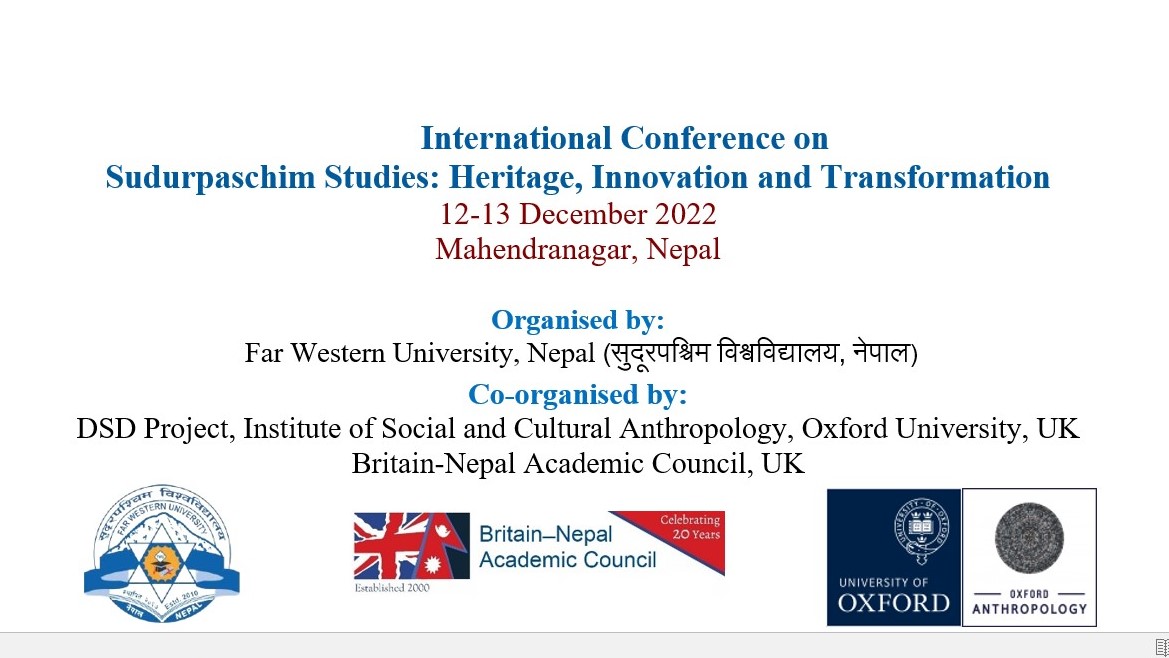
Sudurpaschim (Far West) Province, made up of nine districts, is both ecologically and culturally diverse. Bordering India’s Uttarakhand to the west, Uttar Pradesh (UP) to the south and China’s Tibet to its north, the region preserves cultural and economic ties not only with the people of Nepal’s Karnali region to the east but also across international borders in the other directions. In the past, the boundaries between these various regions were fluid. Known as a gateway to Kailash and Mansarovar, home to the deities of the Hindu pantheon and numerous pilgrimage sites, following the fall of the Khas Empire in the fourteenth century, much of today’s Sudurpaschim was fragmented into small principalities known as the baise kingdoms (lit. 22 principalities). This region is still largely inaccessible and has the highest level of poverty and the lowest human development indicators in the country. To provide for their families, many people have to migrate (mostly seasonally) to India for low-paid menial work. This is not only due to difficult geographical conditions and extreme weather, but also owing to the distance from the capital and persistent neglect on the part of the government. Though a number of studies have been conducted in the region, there is a serious lack of critical and consolidated academic attention to the province as yet. It is evident that there is a dearth of reliable academic data and documentation in a number of fields. Sustained academic engagement is required to generate a comprehensive body of knowledge on Sudurpaschim. Knowledge production should also contribute meaningfully to future policy-making on the part of government, development workers, and others. Aiming at raising the international and national profile of Sudurpaschim, this conference, being the first of its kind, expects to bring together scholars engaged in diverse fields of studies from across the globe who have researched in the region or its geographical or cultural proximities, to share and discuss their work and, thereby, to contribute to the formation and augmentation of the discourse on Sudurpaschim. This is a multi-disciplinary conference, including but not limited to the following broad themes:- Society, culture, and history
- Agriculture, food security, and livelihoods
- Science, technology, and engineering
- Health, population, migration, and development
- Policy, planning, and governance
- Education and pedagogy
- Environment, ecology, and climate change
- Entrepreneurship, business, and economy
- Innovation
- Policy implications
- Policy-round tables
- Keynotes and invited lectures/presentations
- Student-focused sessions
| Submission of proposal/abstract: | 30 June 2022* (deadline extended) |
| Notification of acceptance | 15 July 2022 |
| Submission of full paper/extended summary (3,000-5,000 words) | 30 September 2022 |
| Registration for presenters | 1-31 October, 2022 |
| Registration for Participants | 1 November- 5 December 2022 |
| Participants | Online | In person* |
| Professionals (outside South Asia) | USD 10 | USD 30 |
| Professionals (Nepal and South Asia) | NRs 500 | NRs 2000 |
| Students | Free | NRS 1000 |